Stephan Reusse Cologne 2026
What Remains?
What remains of an object when its familiar appearance is taken away? Does it retain its meaning, or does its meaning change with the way it appears to us?
A vase, at first, remains a vase. We recognize its form and associate it with a function, a material, and a particular idea of what a vase is. But what happens when color, materiality, and surface are no longer visible, and only a reduced form remains?
How much of an object’s appearance must be removed before something like a perfect form remains—a form that no longer refers to the specific object, but to an idea that manifests itself in our memory?
Perhaps we no longer recognize this particular vase, but rather a general idea of a vase. The individual object recedes, and a form emerges that seems familiar even though we cannot connect it to any specific object.
This raises the question of what recognition is actually based on. How much information do we need in order to identify an object? And at what point does its meaning begin to shift?
An opening may be enough for us to recognize a form as a vessel. A curve may evoke a body, an egg, or an organ. A horizontal form may appear simultaneously as a bowl and a horizon. The less information we are given, the greater the space for possible meanings seems to become.
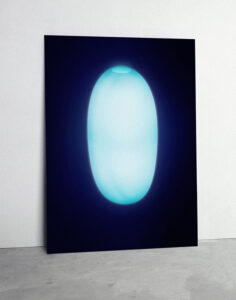
Vase 2026, from „Leaving Shadows“ Fine art print behind acrylicglass
The loss of information does not necessarily lead to a loss of meaning. Perhaps the opposite occurs. As the specific object recedes, other images, associations, and memories begin to emerge.
Meaning, then, may not be a fixed property of the object. It arises in the relationship between what appears before us, what we already know, and what we remember.
This also calls the boundary of the object into question. As long as it remains clearly distinct from its surroundings, we perceive it as an autonomous body. As this distinction begins to dissolve, its appearance changes as well. The object itself may still be present, while the image that made it visible to us disappears.
Presence and visibility, then, are not necessarily the same.
Perhaps this also points to a more fundamental relationship between object and image. An image can make an object visible, while at the same time removing some of its properties. It may be precisely through this reduction that another form of perception becomes possible.
The question, then, is not only what we see, but also how little we need to see in order to recognize something—and at what point the object becomes an idea.
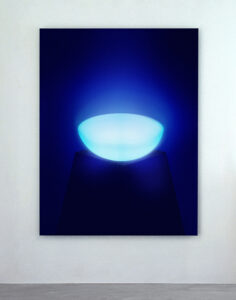
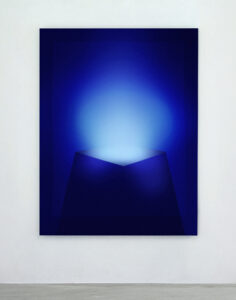
Bowl / Leaving Space 2026, from „Leaving Shadows“ Fine art prints behind acrylicglass
S.R. 2026