Stephan Reusse Cologne, July 2025
The Empty Space
When I look at Rothk.0 today, it seems to me that the work began with an empty place. At the time of its making, I probably would not have called it that.
It began with a simple observation: a painting had been removed from a museum wall. To the eye, little had changed. Only the thermographic gaze revealed that a slight difference in temperature remained on the wall. It lasted only briefly before gradually adjusting to its surroundings.
After many years of working with thermography, making such differences in temperature visible was nothing new to me.
With Rothk.0, however, I became increasingly interested in something else. Looking at the images, I recognised a familiar pictorial form within the thermal fields. At some point, the name Rothko came to mind. It was not about a particular painting, a specific composition, or the colour of his works. What mattered was the act of recognition itself.
The camera had registered a difference in temperature. I began to recognise an image within it that was not materially present. When making the works, I did not initially connect these two processes. I now see them as two aspects of the same experience: on the wall, there was a measurable change that existed only for a short time. In the act of seeing, the memory of an image emerged.
Between the two, a new image came into being.
This also shifted a question that had long accompanied my work with thermography. It was no longer simply about what could be made visible, but increasingly about what we actually see when we look at an image.
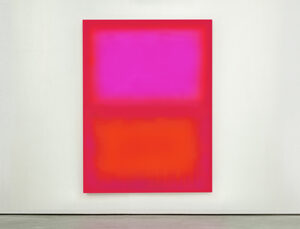
Rothk.0 #13.4, (Fine Art Print behind Acrylic Glass (matte), 2023
Seeing does not happen without prior experience. We look at images against the background of other images we already know. Some we remember consciously; others have become part of our visual experience without our knowing when or where we first encountered them.
I remember.
This distinction shifts the image from the photograph to the act of looking. The thermographic image provides something to look at, but what emerges from it as an image also depends on what the viewer brings to it.
This changes the meaning of the wall as well. Once a painting has been removed, the wall retains, for a short time, the physical effects of its presence. At the same time, it becomes a place where absence can be perceived.
The painting itself is no longer there. Thermography does not restore it. It merely shows that its presence has left a change behind.
Memory works in a similar way. It does not reproduce the past unchanged, but connects it with the present. This became increasingly important to me as I continued to reflect on the works.
This is not only a matter of personal memory. Through repeated encounters, certain images and pictorial forms become part of our visual experience. They influence how we perceive other images, even when we do not consciously recall them.
In Rothk.0, two different processes therefore come together: on the wall there is a measurable thermal change; in the viewer, a visual memory emerges.
One is on the wall, the other in the act of seeing.
I am therefore less interested in the formal proximity of these works to Rothko than in the question of how that proximity comes about in the first place. How little is needed for us to recognise an image? A surface, a difference, a relationship between forms may already be enough.
The rest emerges in seeing.
The title Rothk.0 has also taken on another meaning for me. The zero suggests less an erasure than an open state. The painting is no longer there, the place has been vacated, and something else can emerge.
For me, this is the significance of the empty place. When the works were made, this place was initially quite concrete: the wall after a painting had been removed. I now understand it more broadly, as an open state that can become the starting point for an artistic process.
When I look for a term for what remains on the wall and in the act of seeing, I arrive at trace.
When making the works, I would not have approached them through this concept. Today, it seems appropriate to me. Not as evidence or as a substitute for the vanished image, but as the consequence of a presence.
On the wall, this trace can be measured only for a short time. In seeing, it can remain for much longer. The empty place, then, is not truly empty. It contains the conditions for something else to become visible.
S.R. 2025