Stephan Reusse Köln Juli 2024
How Images Become Memories
Looking Back at My Work Since the Early 1980s
When I look back today at the work I have made since the beginning of the 1980s, I recognize connections that at the time I understood more intuitively than theoretically.
At first, the different bodies of work may seem quite distinct: chemical image processes, the Blind Performances, the Safari actions, the Collaborations, and later the thermal and light-based works. Over more than four decades, the materials, techniques, and situations have changed.
One question has remained:
How does an image come into being?
I was never interested solely in the finished photographic image. From early on, I was concerned with the process of its emergence—materially and temporally, and later increasingly in bodily and social terms.
For me, the image was never an endpoint.
It was an event.
In the early 1980s, I began working with chemists to develop processes in which already developed photographs could be made invisible again. Through another chemical process, they would later reappear.
A finished image lost its seemingly final state.
It was visible.
Then it disappeared.
And finally it appeared again.
This simple experience stayed with me for a long time. An image could be withdrawn from our sight and still continue to exist.
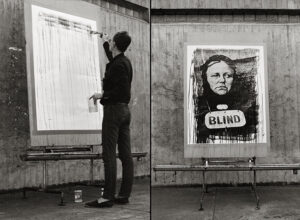
from “the Cultural Memory of Photography”, 1982
In 1982, this led to a series of public performances under the working title the Cultural Memory of Photography, in which photographs of blind people slowly became visible before an audience through a chemical process. The performances were accompanied by Tibetan chants.
I was not interested in spirituality in any narrow sense. Rather, the chants changed the rhythm of the space. They slowed down perception. The audience waited for an image that did not suddenly appear, but gradually emerged from a white surface.
The development of the photograph itself became a temporal event.
Originally, I had photographed blind people myself and had also invited them to make their own portraits using a self-timer. The conversations that grew out of this quickly led into social and political questions. Those discussions were important, but I realized that something else interested me even more.
What does it mean to see when the gaze is not returned?
I therefore began to use not my own photographs, but iconic images of blind people from the history of photography.
The people depicted could not return the viewer’s gaze. This created a peculiar sense of unease. Visitors told me that they suddenly became aware of their own position—sometimes even with the uncomfortable feeling of becoming a voyeur.
The work became less and less about blindness.
It became about seeing.
At the time, I did not know the writings of Maurice Merleau-Ponty. Only much later did I encounter in his work an understanding of perception that felt strangely familiar to me.
Seeing, in this sense, does not mean standing outside a finished world and simply taking it in. Perception arises through our relationship with the world—through the body, through movement, through proximity and distance.
When I encountered these ideas, I thought back to my early works.
I had not had philosophical terms for them.
I had made images disappear.
I had photographed people who could not return my gaze.
I had made the audience wait.
Looking back, I recognize these as attempts to unsettle seeing itself.
Theory did not lead me to these works.
The works later led me to the theory.
At the same time, already in the early 1980s, I was observing the growing flood of private photographs. Inexpensive pocket cameras made it possible to produce and preserve ever more images.
But I was less interested in the quantity than in the selection that takes place over time.
Why do certain images remain?
Why do others disappear?
When does a photograph made at a particular moment become an image that still carries meaning decades later?
In the Safari actions, this question shifted again.
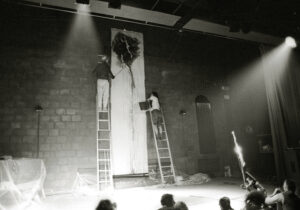
Performance „Safari III“ (Giraffe), Porto 1987
The development of the image became a public act. Time, material, and physical labor were part of the photographic process. The photograph did not document the performance.
Its development was the performance.
With the Collaborations, another dimension emerged.
The photographs grew out of conversations, encounters, shared actions, and symbolic interventions with artists of my generation.
At the time, these works were part of the present.
Today, I see them differently.
Many years have passed. Situations, conversations, and contexts that once seemed self-evident no longer exist. The photographs show individual people, but at the same time they preserve something more difficult to name: a space of communication, a particular form of artistic encounter, a time.
Here my work touches on a second question:
How does an image become memory?
Only many years later did I encounter Jan Assmann’s ideas about cultural memory. His understanding of memory as a cultural process continually reactivated through images, rituals, and symbolic acts came surprisingly close to my own experience.
It also made me think again about the working title I had already used in 1982:
the Cultural Memory of Photography.
At the time, I had not taken the concept of cultural memory from a theory. It emerged from the work itself and from my question as to why certain photographs remain present over long periods of time while others disappear.
Looking back, that early formulation now seems like an indication of a question that had accompanied my work for far longer than I could have known at the time.
Here too, theory did not lead me to the work.
The work later led me to the theory.
Images do not simply preserve the past.
They change with us.
A photograph from 1982 may materially still be the same photograph today. But it now exists in another time. People look at it through different experiences. Some contexts have disappeared; others have emerged.
The image has remained. Its present has changed.
For me, this is one of the connections between the early chemical works and my later work.
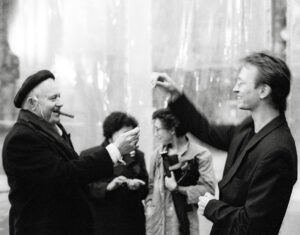
Vostell /Reusse aus „Collaborations“, Berlin 1986
At the time, I made images disappear and reappear.
Today, I am interested in what happens to an image when years and decades lie between the moment it was made and the moment it is seen again.
Merleau-Ponty helped me understand something about the question of how we see.
Assmann gave me a way of thinking about how images continue to act across time.
Between the two lies my own history with these works.
When I look back today, I therefore do not see a straight line. I see works that emerged at different times and from different situations.
But I recognize the questions.
Some were there from the beginning.
Others I was only able to name much later.
And some images have taken longer than I have to reveal what they have become.
S.R. 2024