Stephan Reusse, Cologne 2024
Traces in the Continuum of Time
60 Minutes / Wolves
Wolves move through a world in which perception extends far beyond the immediately visible moment. For them, a landscape consists not only of what is present at any given instant. Scents and traces carry information about animals and people who have already left a place, about movements that occurred hours earlier, about directions and distances. The space of the present therefore always contains information about its past.
This suggests a different experience of time. While human perception is strongly oriented towards the visible and therefore towards the immediate present, the wolf’s sense of smell opens up a reality composed of temporal layers. A trace belongs to the past and yet remains present. It can be detected, followed, and related to other traces. Past and present do not exist as separate states but flow into one another.
A wolf therefore follows not only a trail through space, but also a trail through time. Every scent has a duration. It emerges, changes, disperses, and gradually loses its intensity. This transformation itself carries information. The landscape becomes a fabric of different temporalities in which older and more recent events can coexist. What may appear empty or uneventful to the human eye can, for a wolf, be filled with past movements and encounters.
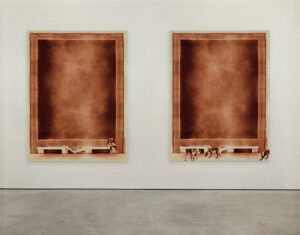
Wolves 2024 (thermogr. images.)
In the two photographs, this relationship becomes tangible. In the first image, a man sits on a broken stone bench in front of a building. Heated by the sun, the exterior wall is transformed by the thermal camera: it seems to detach itself from its architectural function and takes on the appearance of a large, almost monochrome painting. In the photograph taken later, the man is gone; wolves explore the same place, their noses close to the ground as they pick up and follow traces. The camera visually connects these two moments, while the wolves’ perception establishes another, invisible connection between them.
From this perspective, the images can be understood as an approach to a form of perception in which time does not consist of isolated moments. Instead, it appears as a continuum. An event does not end completely once its origin has disappeared; it continues through the traces it leaves behind. The present moment carries within it something of what came before.
This also touches upon a fundamental quality of photography itself. A photograph connects different moments in time. It is created at one particular instant but is always viewed from a later one. What appears present in the image already belongs to the past. In its encounter with the perceptual world of wolves, this photographic temporality acquires another dimension: the past is not merely preserved as an image but understood as something that continues to resonate within the present.
The wolves thus become readers of a landscape composed of temporal layers. Their perception connects the present with what has already occurred. Time no longer appears as a linear sequence of completed moments, but as a continuous layering of traces. The past is not simply what has disappeared. It remains part of the present—fading, changing, yet still perceptible.
S.R. 2024