Stephan Reusse Cologne 2016
Three Seated Portraits
Attitude, Time, and Photographic Intuition
I see the three portraits of Rob Scholte, César, and Harry Kramer as a group of seated portraits. Scholte is sitting on a suitcase at Frankfurt Airport, César on crates of wine and spirits and Christmas gifts, and Harry Kramer on a chair, wearing a bathrobe, with an oxygen tube and a cigarette.
What interests me in these images is not primarily the traditional artist portrait. I am not trying to capture a personality as accurately as possible, nor to define an artist through his work. What matters to me is the situation that develops between the person portrayed, the place, the objects that are present, and my own perception.
The seated portrait is an old form. In art history it is often associated with presence, status, and sovereignty. In these three photographs that structure remains visible, but it has been displaced. The seat is not a representative chair, but a suitcase, a crate, or a simple armchair. The figures occupy their place, but the situation around them is unstable, or at least ambiguous.
In the discussion at the time, Gebhard Streicher explicitly referred to the portraits of Scholte, Kramer, and César as a related group of “seated portraits” and pointed to their art-historical tradition.
My Working Method
When I make portraits, I generally try to enter a situation as openly as possible. I do not develop a finished image in advance and then simply execute it. Of course I have ideas, and sometimes I bring something with me that may prove useful. But I do not want to determine the situation beforehand.
Through conversation with the person I am portraying, through the location, the objects that are there, and through gestures, an idea for the image gradually develops. At the Munich colloquium held in connection with my exhibition at Kunstverein DG, I described my work less as personality photography than as a dialogical process of creating an image. Elisabeth Hartung likewise described the portraits as the result of an exchange in which situations are tried out until an image begins to emerge.
Today I would describe this working method as situational staging. I stage an image, but I do not determine its outcome in advance.
So rather than preparing an image, I prepare the possibility for an image to emerge.
Intuition plays an important role in this. By intuition I do not mean premonition. When I photograph, I often perceive constellations whose significance I cannot yet fully articulate at that moment. A gesture, an object, or a spatial relationship feels right before I know exactly why.
This openness is essential to my portraits.
Rob Scholte
The portrait of Rob Scholte was made only a few months after the car-bomb attack in which he lost both legs. We had already intended to make the photograph before the attack. The event suddenly stood between our original arrangement and the actual portrait session.
We had only about half an hour for the photograph. Rob was shortly about to fly to Madrid. As a precaution, I had brought a suitcase with me, but I did not have a finished image in mind. Rob later recalled himself that the suitcase and shoes were there, but that the exact situation only developed through our working together.
I found the airport particularly powerful for this situation. Everything there has to do with movement: arrival, departure, luggage, mobility. Rob is sitting in the middle of this system.
The shoes in front of the suitcase were important to both of us. Rob saw them more directly as legs or prostheses. I did not want to restrict them to this one meaning. I wanted the situation to remain open enough to allow for several readings. We already discussed this difference in emphasis at the time.
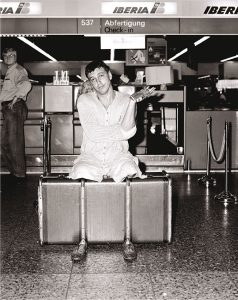
Rob Scholte 1997
For me, however, the decisive element was the gesture.
I did not want to portray Rob as a victim, nor did I want to make an image of his distress. I wanted a large gesture that expressed an attitude rising above the immediate situation. In the discussion at the time, I described it as an attitude that goes “beyond any sense of personal distress.”
That was the central idea of the image.
Rob’s later remark, “Well, gone is gone …,” was not part of the original conception of the photograph. It was his later response to the finished image. At the same time, he said that the portrait had affected him deeply and had shaken his self-image.
The photograph was later described by many as iconic. I think this effect has to do with its strong reduction. There are only a few elements: body, suitcase, shoes, and gesture. The specific story remains visible, but the image is not limited to that story.
César
The portrait of César came about very differently. The crates of wine and spirits and the Christmas gifts were already there in the room. After a long night, the idea of having him sit on these things developed quite spontaneously.
I had no symbolic intention. The crates were not a metaphor, and the gift basket was not an allegory. The objects were simply there, and the situation worked for me as an image.
For me, this portrait shows particularly clearly how photographic intuition operates. At the moment I take a photograph, I do not need to know every meaning that may later be found in the image.
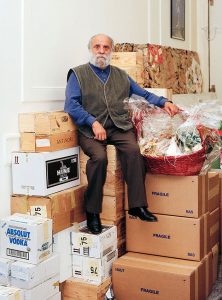
César Baldaccini 1997
César died about a year later. At the time of the photograph, I knew nothing that would have given the image any particular proximity to his death. Nevertheless, that later knowledge changes the way we perceive the photograph today.
This is especially true of the word FRAGILE, visible on the boxes. At the time of the photograph, it was simply a label on packaging material. Today the word can be read differently.
I would not turn it into a deliberate or prophetic sign. What interests me more is the fact that a photographed detail can later acquire a significance that was neither planned nor conscious at the moment the photograph was made.
The image itself remains unchanged. What changes is the way we look at it.
Harry Kramer
With Harry Kramer, by contrast, the situation was immediately visible. He was seriously ill with a lung disease. The portrait was made a few months before his death. He is sitting in a bathrobe, with an oxygen tube in his nose and a cigarette in his hand.
The combination of the oxygen tube and the cigarette is drastic, but I did not want to dramatize the image. What mattered to me was Harry’s composure.
In the discussion at the time, I described the tubes, with a certain dark humour, as a kind of Dalí moustache, and I also referred to the literary quality of the image. Harry had a strong interest in literature, and for me the situation had something of Thomas Mann about it.
Ben Willikens described the photograph at the time as a “staged death.” At the same time, he stressed that such an image could not have been made without Harry’s own willingness to engage with the situation.
I myself see the photograph less as an image of death. I am more interested in this immediate state of being: Harry is sitting there, smoking, holding the cigarette himself, and remaining completely present.
His physical limitations are visible, but they do not determine the image on their own.
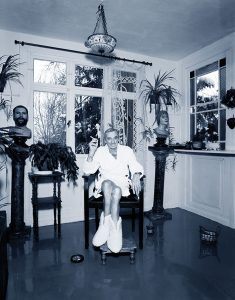
Harry Kramer 1997
Attitude and Distance
For me, the concept of attitude connects the three photographs.
Attitude first refers to physical posture. At the same time, it describes the way in which someone relates to a situation.
With Scholte, it is the large gesture following an irreversible event. With Kramer, it is the composure within an extreme physical condition. With César, it is the natural presence within what was initially an incidental constellation whose meaning changed only later.
I am not interested in making a definitive statement about who these people are. I try to create or recognize a situation in which something of their attitude becomes visible.
Distance is important to me in this process.
At the time, I said that I consciously exclude pathos and that I measure the quality of emotion by the quality of the visual distance. My aim is not to produce emotional shock or sympathy, but to make structures of thought and attitude visible.
For me, distance does not mean an absence of emotion. It prevents illness, injury, or death from becoming an effect.
Elisabeth Hartung described this very precisely in relation to Scholte and Kramer: the photographs conceal neither the accident nor the breathing apparatus, but they also do not expose the people portrayed to the viewer’s appetite for sensation.
Time
Today I also see a different temporal structure in each of these three images.
With Rob Scholte, the decisive event has already taken place before the photograph.
With Harry Kramer, the physical limit is immediately present at the moment of the photograph.
With César, part of what we know today only enters the image afterwards and changes the way it can be read.
In the discussion at the time, Georg Christoph Tholen spoke of “singular moments of transition” and “ruptures in the fabric of time” in relation to my work. I find this idea particularly relevant to these three portraits.
I therefore do not see them as a series about death. Death plays a different role in each of the three images, but it is not their common subject.
What connects them for me is the relationship between attitude, time, and photographic perception.
Photography fixes a particular moment, but the meaning of that moment does not remain fixed. Lives continue, knowledge changes, and details are perceived differently later on.
For me, this is part of photographic intuition: taking a situation seriously without already having to know everything about it.
That is why I try not to determine too much when I make a portrait. I need a certain degree of preparation, but just as important is the willingness to abandon my own initial idea.
For me, the image emerges where perception, situation, and response come together.
I do not need to know the image in advance.
I need to recognize when it is there.
SR. 2016